
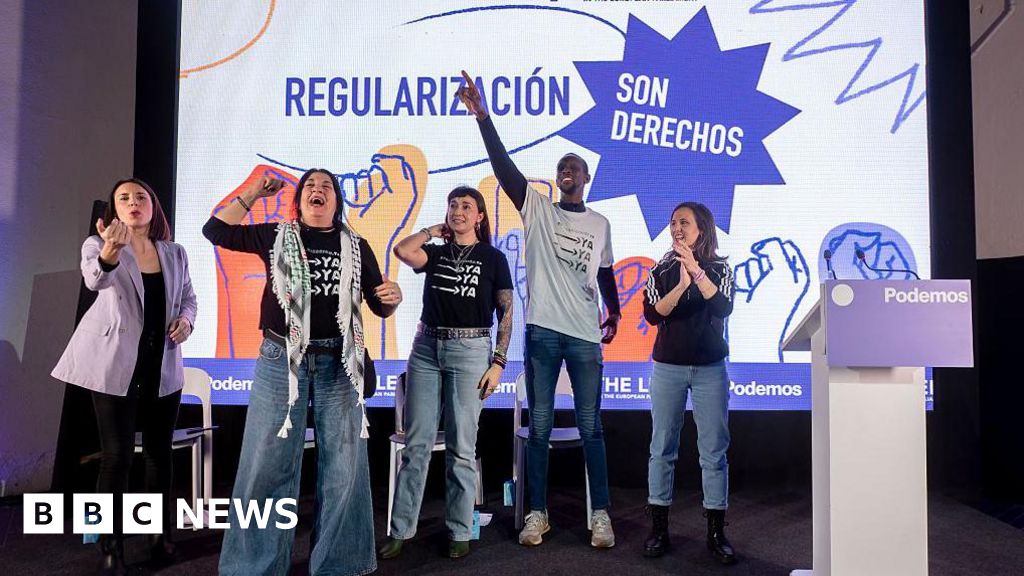
spain is generally pretty good about helping undocumented immigrants normalize their status. I know a ton of people from colombia who have moved to spain over the years. almost none of them did it legally. many are citizens now.
none of them had to spend any time in concentration camps.
We are inevitably going to have a very right wing government here in Spain — Sanchez is running on fumes and the left is in disarray — but Sanchez has been pretty decent on immigration. His line is that the demographic crisis in Spain makes mass immigration economically essential, full stop, which isn’t a perfect take ofc, but it’s nice to see a socdem not falling into the trap of triangulating on this issue.
Tbh Spain is in a very weird place right now. You see examples of increased racial tolerance and integration everywhere on the one hand, but on the other it seems like every middle class person you speak to these days is unafraid to chew your ear off about how much of a fascist they are.
The electoral left has completely fragmented (party funding rules tend to guarantee this) but then the Palestine solidarity protests were quite impressive, especially considering that the government’s line was at the less-bad end of the NATO spectrum. Communist movements seem quite active at the street level — and the memberships seem to be pretty young, which is an encouraging sign imo
In conclusion, Spain is a land of contrasts yada yada
deleted by creator
So you’re saying I should just move to Spain and wait it out instead if I want to escape the US?
I moved to Spain last spring. I have citizenship through blood tho. I love paying 50 euros to fill my grocery cart, free healthcare, and public benches.
Still getting used to the euro-racism and bafflingly terrible bureaucracy tho.
they have a low growth rate like most developed countries so you’d be doing them a favor tbh
you could do worse but I think they’re getting sick of gringos driving up the rent
Don’t worry, I’m poor as hell and downwardly mobile. I just don’t want to be murdered for being trans.
Your mileage may vary wrt to that. Catalonia or the Basque country seem to be the more progressive bits.
Trans Healthcare is pretty hard to access though.
Not that we don’t have concentration camps in Spain. Illegal immigrant “criminals” often get deported, and the cops in the facilities are famously not the good ones, to the point that it’s normalized that they’ll call them by a number and not by name, and they’re often denied medical care. Extremely dehumanizing stuff.
Huh… that’s nice. I honestly only knew them, immigration and refugee-wise, for the militarized Ceuta-Melilla border in Morocco. I can see why people try to make through the border.
How socialist is the government? I found this but im too lazy to read (i’m at work)
I assume the nation is socdem, typical European socdem, with Spanish characteristics. At least it must be less worse than France or Germany.
They do seem a little bit better than average Euro succdems. It might also just be me being used to some of the most fash succdems so the average looks good in comparison.
That’s a decently accurate assessment.
Spanish here: almost entirely EU socdems. Two of the most important premises of the government coalition were to:
-
Eliminate the infamous “reforma laboral” (worker’s rights reforms) carried out by the christian conservatives during the post-2008 crisis, which primarily made it much easier and cheaper for firms to fire people
-
Eliminate the infamous “ley mordaza” (mouthgag law), also carried out by the christian conservatives during the same period, which greatly hurts the right to protest and makes police violence much harder to prosecute
Neither of those has been eliminated, showing the lack of will of the PSOE government to carry out meaningful improvements in economic policy.
Spain being in a particularly advantageous position politically within Europe is due to a few main reasons IMO:
-
Spain is a “poor”, “unindustrialized” country, whose primary export is low-cost tourism. This means that its economy is naturally much less threatened by the rise of China’s industry. On the contrary, cheaper consumer goods here are much less controversial. We do have automotive industry, so it would take a hit, but comparatively less than many richer nations in Europe. Additionally, Spain has a great historical and geographical link to Latin America (unfortunately for the Latin American peoples of old), sharing a language, possessing seaports on the Atlantic and the Mediterranean, and controlling to a degree the Strait of Gibraltar (remember the African cities of Ceuta and Melilla belonging to Spain being exclaves off the northern coast of Morocco). Spain could be a key link between Europe, China (new silk road) and Latin America (Atlantic trade). It’s also a huge and rather unpopulated country with lots of wind and sun and without fossil fuel deposits, so it’s perfect for renewables (as proven by its current construction of Chinese-firm electric battery factories in mainland Spain).
-
Catalonian and Basque nationalism. Both of them have quite strong leftist movements within them (though there’s also plenty of reactionary right wing nationalists). The centralist, Spanish nationalist right wing of the two main right parties in Spain (PP - christian conservatives, VOX - far-right mixture of neoliberalism and Franco “nostalgics”) have absolutely alienated everyone in Catalonia and Euskal Herria by promoting a very centralist repressive understanding of “Hispanity” and preventing by all means any referendum for independence in either region. These regions have enough voters that it’s almost impossible to conform a government coalition without the nationalist parties of Catalonia and Basque Countries, and it’s unthinkable for the following 5-10 years to see any nationalist party from those regions supporting either of the two right wing parties in government, it would be political suicide.
-
Spain is on the opposite corner of Russia in the continent, so the “anti-Russia” discourse is much less powerful here. Like, nobody here really gives a fuck about the territorial integrity of fucking Estonia or Poland. Being also a very tourism-driven country, the authorities are very careful on having bad relations with anyone, because bad relations implies less tourism, and that’s less line going up. This has allowed Pedro Sánchez to, at least according to his words, avoid the 5% GDP expenditure in NATO, so far the only country to try and sneak out of it. We’ll see how well that translates into actual policy. Spain also didn’t formally participate in WW2, so it’s not a central issue in public discourse or even public education and history lessons, so people really don’t care about the Motherboard-Ribbedcock pact propaganda and russophobic shit like that.
-
No a la guerra and 11-M. The anti-Iraq invasion protests were extremely followed in Spain, likely because they were used as a political weapon by the PSOE (socdem party) and all its media apparatus to hurt the PP. Close to a quarter of the country was on the streets protesting, the war was exceedingly unpopular, and “No a la guerra” and pacifism are still very popular points of view among the general progressive population, nothing like the bloodthirst for Russians of the average German SPD voter. The 11-M terror attacks in Madrid carried out by Al-Qaeda also left a big imprint on people on the consequences of state participation in war, because again, the PSOE and its media apparatus used it as propaganda against the PP. Very different from the bipartisan reaction in the USA to 9/11.
-
Latent memory of fascism. My parents (I’m not even 30) remember literally raising their hand in the fascist salute and singing “Cara al Sol” (a Fascist anthem) at school and in summer camps, Franco died in 1975! Most people older than Gen-Z, except for so-called “nostalgic” boomers, do not want a return to fascism, and the state propaganda has done a good job of whitewashing the “super nice and great transition to our wholesome democracy”. Gen-Z are already distant enough in time that fascist propaganda is effective on them, but it’s mostly not the case for people aged 20 to 65. The collective opinion is generally that the army are a bunch of fashies (bad propaganda after the Failed Tejero coup attempt post Franco’s death), are glad that compulsory military service was removed some decades ago, and would much rather have funding of pensions than of weapons.
-