

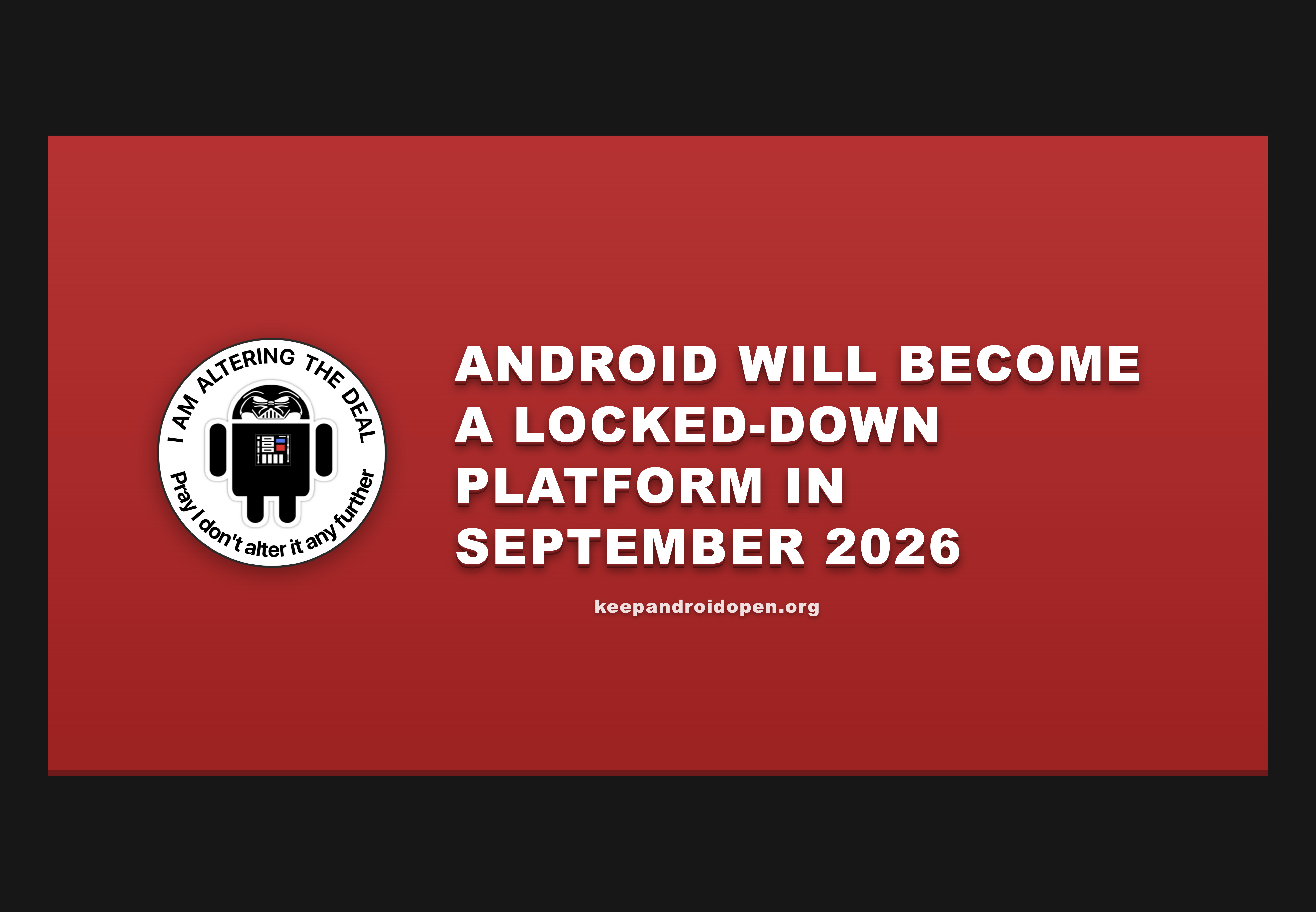
If you haven’t seen this yet, Google is planning to require mandatory developer identity verification for all Android apps, including apps distributed outside the Play Store, taking effect September 2026. This affects every independent and open source Android developer directly.
This is not just about the Play Store. After September 2026, on any certified Android device, applications from unverified developers will be blocked by default. The only proposed bypass, the “advanced flow”, exists only as a blog post and has not appeared in any beta, dev preview, or canary release. No one outside Google has seen it.
The community has been fighting back at keepandroidopen.org:
- Read the full breakdown of what this means
- Sign the open letter (organisations only)
- Contact your national regulators — contacts listed by country on the site
- Add the countdown banner to your project
September 2026 is closer than it looks. The time to push back is now.
They’re not wrong.
Of course you can fork and have full control over your fork, but Graphene and company want to be able to keep merging AOSP’s code to keep up with features and improvements.
Merging code from a divergent codebase is harder the more divergence there is, and with big codebases it can easily overwhelm small and medium-sized teams.
It’s the same reason there aren’t lots of chromium forks with manifest v2 support, while it is technically feasible, it requires a bigger effort than most projects can afford.
Keeping an open AOSP fork is not a bad idea, but it’s not clear whether GrapheneOS or any other project will be able to keep up with that workload.
Of course Linux phones require a lot of work too, but it’s work oriented towards making it work instead of towards undoing whatever sabotage google ads to AOSP, so it might motivate more people or be easier to do.
Also, both approaches are compatible.
Linux phones can use waydroid, which depends on AOSP, to run Android apps.