

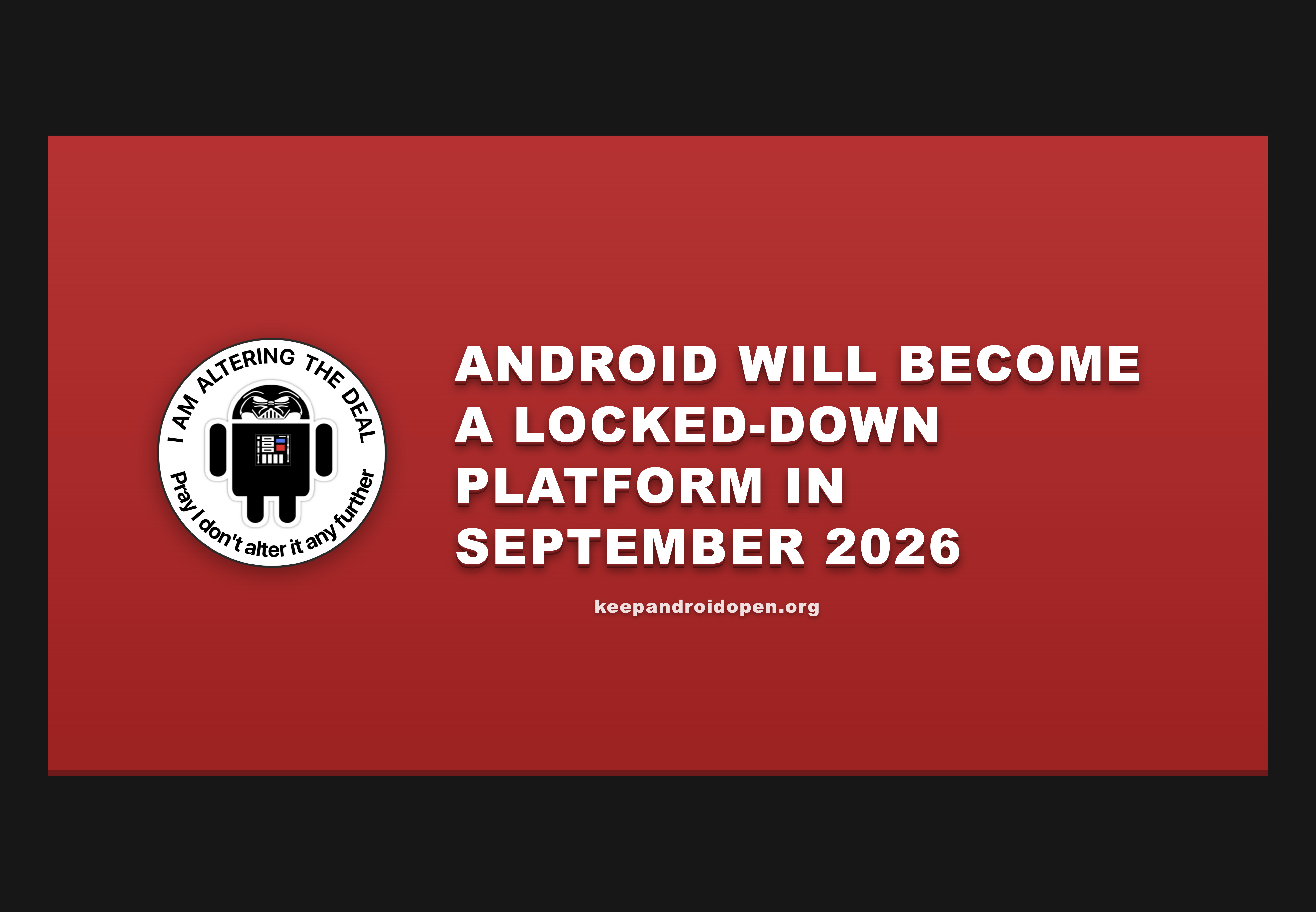
If you haven’t seen this yet, Google is planning to require mandatory developer identity verification for all Android apps, including apps distributed outside the Play Store, taking effect September 2026. This affects every independent and open source Android developer directly.
This is not just about the Play Store. After September 2026, on any certified Android device, applications from unverified developers will be blocked by default. The only proposed bypass, the “advanced flow”, exists only as a blog post and has not appeared in any beta, dev preview, or canary release. No one outside Google has seen it.
The community has been fighting back at keepandroidopen.org:
- Read the full breakdown of what this means
- Sign the open letter (organisations only)
- Contact your national regulators — contacts listed by country on the site
- Add the countdown banner to your project
September 2026 is closer than it looks. The time to push back is now.
People don’t get it: it doesn’t matter Graphene or LineageOS. Its still Android and will still be bound to the same limitations, unless you go fully degoogled which means give up on internet banking, cardless payments and government apps. (And much more like m Donalds app and more… But I don’t care for those)
We need open trust platform not one controlled by Google, Graphene or lineage are just not valid alternatives. We need a Linux phone.
What about fairphone? A friend has one and choose the “no google” when she bought it. Works kind of apparently.
Ask you friend if the McDonald app works out of the box.
I know, I don’t care for McDonald app as well, but it’s an easy example of a stupid app requiring play certification to work…
There is some sandboxing, so maybe, but I sincerely doubt she has a mcdonalds app lol.
Graphene isn’t a ROM, it is a standalone mobile OS based on the Android Open Source Project. So yes, Google primarily develops it, and has de-facto control. But Graphene is actively working to change that, especially with partnering with OEMs so that they can increase device driver support and give more devs incentive to work on AOSP/Graphene in general. For mobile devices the device drivers are huge, unlike desktop/server linux where MOST (obviously not all) things work.
I beg to defer on the device drivers. Maybe you don’t remember, but it’s been decades before Linux would adapt, reimplement or convince manufacturer to provide drivers for it.
Modems first. Graphics card next. Wi-Fi networks also. Winprinters. They all come to my mind. And it’s only by time and effort that now looks just works everywhere.
And now while graphene indeed is doing a great job that I appreciate very much, at the same time they are not developing an operating system. Google is.
There is a huge effort behind developing a full operating system, and it also requires standardization and somebody who defines what the standards are.
At this point, Google is the only one doing that. And if they go closed doors, no open source AOSP clone could keep up with Google changing standards and still be compatible, which would end up as an incompatible operating system.
My point is that currently Android needs Google, and there is no fooling around. We are years away of being independent from Google, whatever the great effort other developers are doing.
I appreciate everybody’s work and I have been a lineage supporter and maintainer myself.
There are tons of issues that we need to solve to be really independent from Google. Forking he’s the least of those.
I see this take repeated again and again it is simply not true. LineageOS and other FOSS AOSP-derivatives are the best, most-supported and most-accepted FOSS mobile operating systems that we have available to us. And no, you neither have to give up on contactless payments nor on internet banking or government apps. There are many applications that don’t play nice with FOSS Android, but if you make the effort to choose your service providers with intent, so that they are compatible, then it is very much possible to daily-drive a fully de-Googled phone.
I agree with most of everything you wrote.
But banking apps and government apps is not a convenience, is a requirement, especially because, well, by law, they are required to provide an app and there is no choice around it. At least here.
I could indeed go back to bicycle everywhere I want to go and take in the train, but that is not convenience, that is life, so I need a car.
My point is that Google controls Android, whether they graciously allow us to have our foss Android and recompile it from sources is nice, but we still depend on Google and this is not good.
This is what needs to change, and there is no way around it.
People should just stop being so addicted to convenience.
Quit internet banking and cardless payments.
I don’t care for cardless payments, but I do use internet banking, you cannot do without at least here, and government apps too are useful and doing with out is just… Impossible.
Mobile banking is mandatory here, if not able to do mobile banking then you can use non free SMS messages, which sucks.
Government apps mandatory I mean that without, you are cut from most digital government services, which is not practical at all. Survivable, but a pain.
Found the swede? 🇸🇪😁
No, sono Italiano… But I guess it’s similar across the continent…
You say non free SMS messages as if it’s otherwise “free”, but the product is you.
Utility or privacy, it’s your pick. If you value privacy more, you won’t give in to utility.
Government apps are the only one I think are hard to do without.
You talk of what you don’t know. Bank apps here are mandatory by law. If you don’t or can’t use a bank app then you can use a SMS verification approach where you are required to PAY SMS that the bank sends you.
Receiving SMS here is free, only those from the bank for verification are to be paid without the bank app, it’s just a scam to force you to use the bank app.
The bank app itself is not a scam like a you are the service approach, and it’s not free either as you pay the bank services with your bank account fees already. Maybe you don’t pay a specific fee for the app, bit you already pay your home banking fees anyway.
For me its maps. Getting directions is mostly why im still on /e/. I would love a linux phone! But im stuck at the moment.
Well, FairPhone has GPS support on Ubuntu and that opens the world to a bunch of native GPS apps
Note that I haven’t tested this, I’m an iOS user, but Linux with Fairphone is starting to sound better and better. I moved from Android to iOS because Android started feeling so restrictive compared to what it used to be in the single digit version numbers era, it stopped making sense to prefer it over the more convenient OS. Now it seems Linux on certain phones is starting to get usable enough that it can be what Android used to be a decade ago when I still liked it.
Friend have a non-google fairphone and has some maps-like app that works at least well enough.
Her bank app worked most of the time? Guess it’s a cat & mouse game until it’s finally established or killed.
Interesting i may have to give it a shot.
Do let everyone know if you do, I think there’s actually quite a few people here who’d be willing to make the change to Linux if the Fairphone is truly as well supported as the UBPorts website claims
100%. I have one app for work that i also need. Do you happen to know if two oses can work on a phone? Like grub allows?
I don’t think you can, but some apps may work with WayDroid
For now a linux phone will still lack native banking apps, cardless payment and government apps. Unless the app can run on a degoogled OS (Graphene, waydroid, etc.).
By open trust platform do you mean something akin to play protect?
Yes an alternative to play protect/play integrity… But at very least not vendor locked
This is the route I’ve gone, also if you think any bank, or government is going to suddenly support a Linux phone I’ve got bad news
Given an open certification process anybody could apply and achieve that, at least in theory. Something that with play integrity you cannot being obscured and proprietary.
So who knows, maybe one day even a Linux phone could. But not unless we get an open certification approach.
WTF are you talking about?
It’s based on AOSP (open source). They can easily fork Android and do whatever they want. Open source means full control over software / OS.
Starting from scratch has zero benefits, and only means the experience is shitty and app ecosystem is nonexistent.
And those apps which require hardware verification using Google APIs are available on Linux? How does this equate to “we need a Linux phone”?
The issue, as you said, is “we need an open trust platform”. The best path forward is we push for that so that Graphene and anyone else can us it.
Giving up all the open source work and app ecosystem of Android is irrelevant and only prevents 99.999℅ of people from adopting it.
I am sorry to say that forking AOSP is not an easy solution.
I cannot talk for Grafene as I don’t know much of that organization, but I have been part of the Lineage Os organization for a little bit as a maintainer, and I can tell you that nobody is actually able to start working on such an effort as an AOSP fork.
I would gladly be happy if such a work would actually be maintained and supported long time, but I’m skeptical that anybody but a big organization has a power and a resource is to do so. After all even Linux is actually brought along by lots of organizations and also commercial organizations.
Yes, we need an open source trust platform, and I believe that is the only real way forward. I would vouch for a Linux mobile operating system, but indeed, air truly open, Android would be good as well.
They’re not wrong.
Of course you can fork and have full control over your fork, but Graphene and company want to be able to keep merging AOSP’s code to keep up with features and improvements.
Merging code from a divergent codebase is harder the more divergence there is, and with big codebases it can easily overwhelm small and medium-sized teams.
It’s the same reason there aren’t lots of chromium forks with manifest v2 support, while it is technically feasible, it requires a bigger effort than most projects can afford.
Keeping an open AOSP fork is not a bad idea, but it’s not clear whether GrapheneOS or any other project will be able to keep up with that workload.
Of course Linux phones require a lot of work too, but it’s work oriented towards making it work instead of towards undoing whatever sabotage google ads to AOSP, so it might motivate more people or be easier to do.
Also, both approaches are compatible.
Linux phones can use waydroid, which depends on AOSP, to run Android apps.
Graphenes is degoogled and can support play services in a locked down environment so it doesn’t have full control of your entire system. Play services is what is expected to be used to do the verification process.
While play services are mandatory for play cartification, the opposite is not automatic. In fact, bootloader and device fingerprint play an important role and when you replace the stock OS usually play integrity fails by design.
Do you know first hand that you can achieve play integrity with Graphene and no strange tricks like spoof signature or root?
https://grapheneos.social/@GrapheneOS/116261301913660830
Not sure if it applies to users only or to developers making apps too. Anyone knows?
This is a totally unrealted point. This applies to the age verification requirements and not the freedom to install apps outside Google control